
Stop Treating AI Like Google: How Delhi NCR Owners Are Building Their Own Tools
By AI Business Partners · 28 Jun 2026
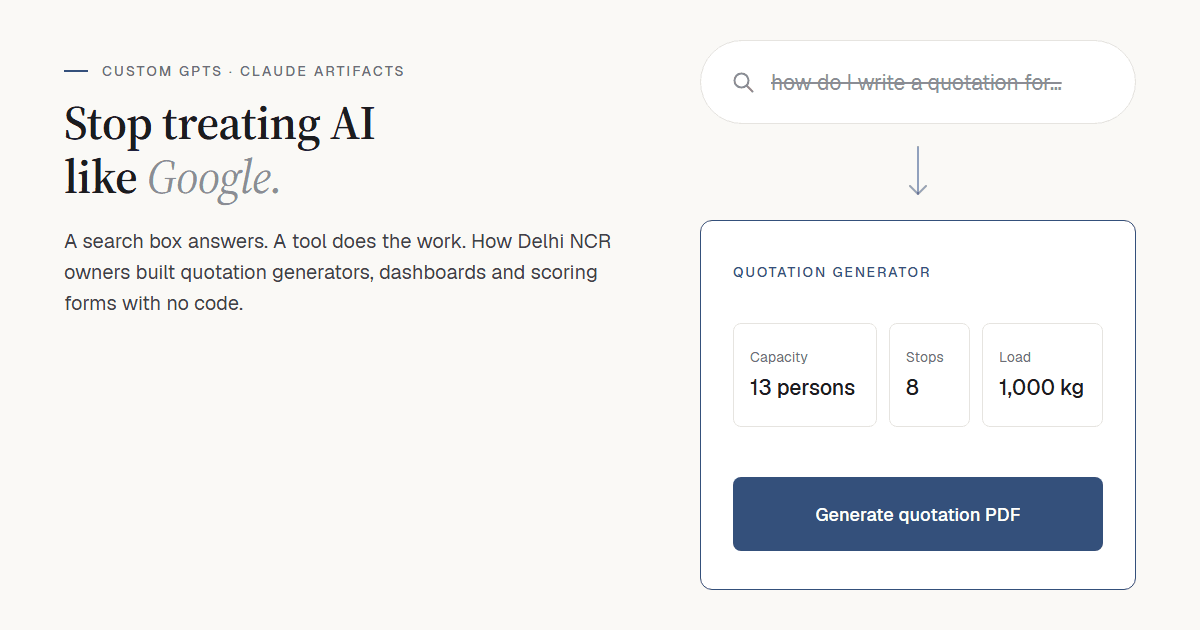
Most business owners meet AI the same way: as a smarter search box. You have a question, you type it in, you get an answer. Useful — but shallow, and it leaves the heavy lifting exactly where it was.
The owners getting real value have crossed a line. They've stopped asking AI things and started building things with it: a quotation generator, a field-team dashboard, a candidate-scoring form. None of them wrote code. That distinction — from passive use to building — is the single biggest shift we see in the room.
The "before": AI as a fancy Google
The starting point is almost universal. Abhishek Kinnu, an advocate and founder of Compli Expert, described it plainly (translated from Hindi): "Before this workshop, I used to think of AI as just Google," and "I was using it like shallow water."
Puneet Goyal, founder of the footwear brand Calcetto, said much the same (translated from Hindi): "Earlier my experience with AI was that we used ChatGPT — whatever question came to mind, just like we ask Google, we'd ask ChatGPT."
Nothing wrong with that as a start. But a search box doesn't reduce your workload. A tool does.
What "building a tool" looks like without code
Two developments have made tool-building accessible to non-technical owners.
Custom GPTs (OpenAI). ChatGPT lets you build your own no-code assistant — give it your price list, your tone, your rules — and reuse it across your team. It is available on ChatGPT's paid tiers, and OpenAI has steadily widened access to lower-cost plans (per OpenAI's own documentation). For a small firm, that means you can encode a repetitive job once and stop redoing it by hand.
Harsh Gupta, director of JB Gupta Enterprises, a manufacturer supplying lift OEMs, built exactly this: "I created a tool for creating uh quotations that we submit to our customers." He feeds it the specs — "passenger capacity is load capacity stops multiple things and it gives us a detailed quotation that to in a PDF format." His next move was the real test of whether a tool is worth anything: "on the Monday morning first I'll be giving this tool to my sales team."
Ankit Birla, project coordinator at Premiere Ancillaries, a construction contractor, built one for a non-technical audience: "I've done custom GPD which is uh very good for for me and the all the employees who working in our company for the civil engineers these are very important because they are not in a technology." His takeaway was the building mindset itself — "do it yourself is a very good thing."
Puneet went past quotations into hiring, pairing a custom form with ChatGPT to screen applicants — in his words (translated from Hindi), giving candidates "a customised form, and ChatGPT can analyse it and score the good candidates."
Claude Artifacts (Anthropic). Claude turns a plain-language description into a working, shareable mini-app — a calculator, a tracker, a simple dashboard — rendered live beside the chat, available on every plan including the free one (per Anthropic, which says users have created hundreds of millions of them).
Vipul Sharma, founder of a modular furniture and interiors firm running hospital projects across Delhi, built a lightweight system to pull his field teams' updates into one place: "we have created one CRM type of a tool for our team members in which they can... provide their inputs uh from the sites and it will be available on one dashboard where we can have a look and see what all outcomes it's coming out from that input."
The payoff — and the catch
The time saving can be dramatic. Abhishek, who used to wait days for someone to summarise spreadsheets, found (translated from Hindi) that after building his tools "it's only a matter of minutes — within five, four, seven minutes you can process even two years of data."
Two honest caveats:
- These are tools, not finished software. Claude Artifacts are excellent for prototypes but can't connect to an external database or run a production back-end; treat them as a fast 70% rather than a 100% replacement for a real app. A Custom GPT is only as good as the price list and rules you give it — garbage in, garbage out.
- The evidence here is early. Harsh hadn't yet run his quotation tool through a live week when he spoke; most owners are at the "deploying it Monday" stage. The build is genuinely quick; the durability of any one tool is something each business still has to prove in use.
Where to start: pick the one document or report you rebuild most often by hand — a quote, a proposal, a recurring summary — and spend twenty minutes turning it into a single Custom GPT or Artifact. That one tool will teach you more than a week of reading about AI.
The point isn't that AI will run your business. It's that a furniture maker, a manufacturer and an advocate each walked out with a working tool they built themselves — and none of them touched a line of code.
Frequently asked questions
Do I need to know how to code to build an AI tool? No. Custom GPTs and Claude Artifacts let you describe a tool in plain English and get a working result — a quotation generator, a dashboard, a scoring form — with no code.
What's the difference between a Custom GPT and a Claude Artifact? A Custom GPT is a reusable assistant you load with your price list, tone and rules. A Claude Artifact turns a description into a small, shareable mini-app rendered beside the chat. Use a GPT for repeatable judgement; use an Artifact for a quick interactive tool.
Where should I start? Pick the one document or report you rebuild most often by hand — a quote, a proposal, a recurring summary — and spend twenty minutes turning it into a single Custom GPT or Artifact.
Want to put this to work in your own business? We've trained 325+ owners across Delhi NCR hands-on, on their own data — see the 2-day workshop or browse the free AI toolkit.
Related articles
Put this to work in your own business
We train 325+ owners across Delhi NCR hands-on, on their own data — in 2 days.