
The MCB Strategist Prompts — Three Free Offers That Get a Stranger to Reply YES
By AI Business Partners · 12 Sep 2026
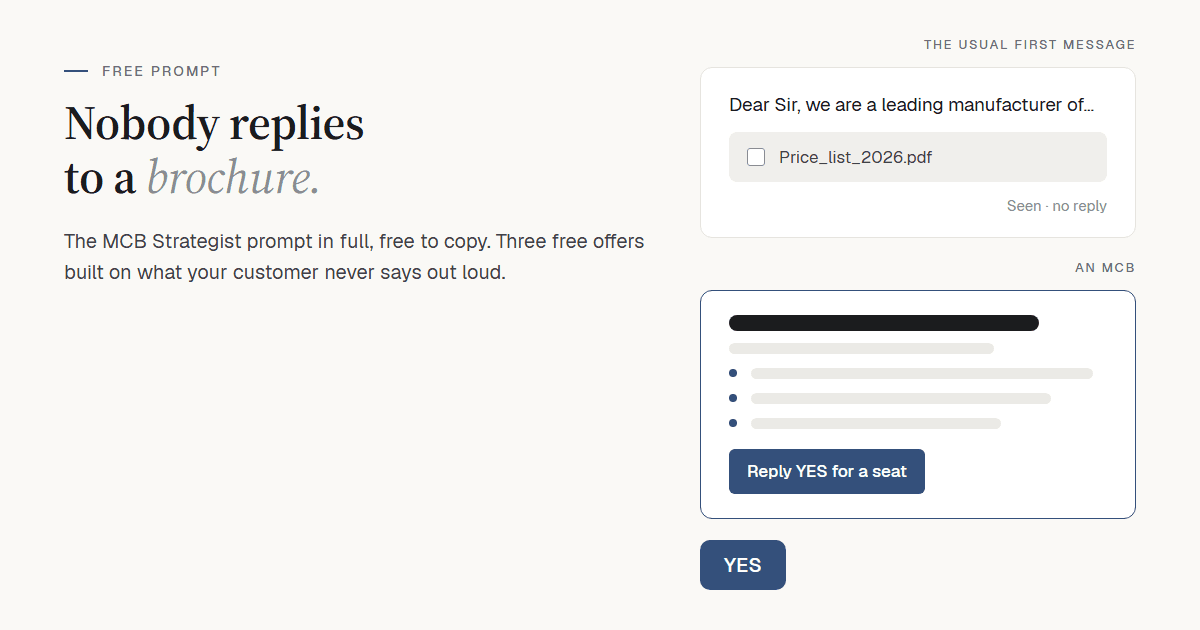
These are two prompts we have just created, and they are for everyone. Both are below in full — free, no sign-up, nothing to buy. They run one after the other in the same chat: the first finds what your customers secretly want, the second writes the messages.
For best results: run these prompts on Claude Opus 5.5 or GPT-6 with thinking effort at maximum and Research (Claude) or Deep Research (ChatGPT) switched on. Sections 1 to 3 explain why.
Keep these ready before you open the chat
The first prompt opens with an Inputs block of sixteen fields. Everything in red below is information you will be asked to supply — gather it before you paste, because whatever you leave thin is what the questions get spent on. Write unknown where you do not have it and n/a where it does not apply. Section 4 explains what each field is for. The second prompt has nothing to fill.
[BUSINESS NAME]and[WEBSITE][PRODUCT/SERVICE]and[TARGET MARKET — the segments, e.g. restaurant owners / hotels / dealers][GEOGRAPHY]and[LANGUAGE(S) MY CUSTOMERS READ, with script — e.g. Hinglish in Roman script][ONE SEGMENT, and who in it decides — or "you choose"]— the one segment this session is for[CUSTOMER QUOTES, or unknown]— what customers have told you they want apart from price, in their words[OFFER — free training / masterclass / 15–20-min meeting / free gift or service; length; live or recorded; date and time; link or venue; price if any, and how it is waived][WHAT I SEND OR DO NEXT — the reply, the link, the education sequence, what the attendee leaves with]— what follows the YES[PAID PRODUCT AND PRICE RANGE]— kept hidden in every message[NUMBERS / NAMED METHOD / CREDENTIALS / CLIENT TYPES / RESULTS / NAMED TESTIMONIALS — only what is true, and where it is documented]— the proof you can truthfully claim[WHATSAPP LIST / EMAIL LIST / META OR LINKEDIN ADS / PRINT / REFERRALS — with list sizes, whether each is warm (knows me) or cold; mark the primary channel and the language(s) it goes out in][LINK / PHONE NUMBER / "REPLY YES" / MEETING BOOKING; for named sends, the per-recipient fields I can merge, e.g. recipient name, referrer name]— how a reader can respond[NAME AND TITLE THAT WILL SIGN][MAIN COMPETITORS AND THEIR HEADLINE PROMISES][PAST MCBs / OUTREACH / ADS, and what they pulled][REGULATORY / BRAND / CLAIMS I WILL NOT MAKE][REGISTER — e.g. Hinglish WhatsApp, formal English email, trader shorthand]— how your customers talk
Most first messages from a business to a stranger ask for the sale: "We are a leading manufacturer of commercial kitchen equipment…", a brochure, a price list, a request to "discuss requirements". Nothing in it is about the reader, so it is ignored — on WhatsApp, in the inbox, in the feed. An MCB does the opposite, and the two prompts below write three of them for you: one finds the secret desires, the other writes on them. First, what an MCB is — the prompts work best when you understand what they are asking you for.
What an MCB is, and why it works
An MCB, or Mass Control Bait, is the short message a business sends to its market in place of a product pitch. It offers something of real value, free; it is built on one thing one group of customers secretly wants; it keeps the product out of sight; and it asks for one small step. Its only job is to earn a reply. Despite the name, it is not about control — the method's own words are showing value, a buying environment and listening mode.
Three things, kept apart
- The MCB is the message — headline, hook, call to action. Treat it as a small product, judged by whether people want it, not as copy judged by how it reads: ask "what shall I give?", not "what shall I write?"
- The offer is the free thing inside — a seat at a free training or masterclass, a 15–20-minute meeting, a free gift, a free service. The value lives here.
- The method is the order: MCB → reply → education → product → sale. The MCB is the first step, never the whole.
Why it works
- Resistance attaches to the product. A pitch invites comparison and the reflex — "we already have one", "reduce the price". Remove the product and there is nothing to compare: your free, useful gift now competes with a rival's pitch, instead of your product fighting theirs on price.
- A real gift creates an obligation, repaid in attention and replies. A hollow one is repaid in resentment, and in a referral-driven market resentment travels.
- A result in advance is proof that you can deliver more — so the offer must deliver a complete result on its own: a working sample of what you sell, not a teaser.
- People do not want to be sold to; they love to buy. Your job is a buying environment. Value creates it; showing the product, stating the price or sending a proposal does not.
- The reply is permission, so what follows is expected rather than an interruption.
- Control of the flow changes hands. Chasing — follow up, call, follow up again — earns a meeting as a favour, then loses it on "do you have a lower model?". With an MCB the reader comes forward, meetings are set at your times, and the meeting is your educational session, not their price negotiation.
- You become the expert, not a supplier. Suppliers are compared; experts are invited, and name their price and terms without haggling over small things.
One segment, one secret desire
Each MCB is written for one segment. A commercial-kitchen equipment maker sells to restaurant owners, hotels, corporate canteens and dealers; each wants something different, so each gets its own MCB — and none mentions an oven. Split wherever the want changes: role in the buying chain, sector, status, city, language (Hindi readers and English readers are separate segments), or desire itself (the restaurant owner who wants a second outlet is not the one who wants to be home before midnight).
Every customer wants things at three depths — here, for the restaurant owner:
| Need | Desire | Secret desire |
|---|---|---|
| Said out loud, acted on this quarter — steady, reliable, consistent | Admitted to a friend — sudden, overnight, on autopilot | Never said among peers — recognition, legacy, freedom, being the best, impact |
| Every table full on weekday nights | A second outlet, then a third | Being the name the city talks about |
The secret desire — also called the magical outcome — is what the customer is really buying, and it is the target. One MCB aims at one; two split its pull until it says nothing in particular.
The words, though, usually sit a row higher. A cold reader does not reply to a promise of "legacy"; they reply to what they are short of this quarter, stated with magnitude — a number, a timeframe, a superlative, an objection removed — that reaches who they want to become. "Fill every table on weekday nights within 90 days — without discounts" takes the restaurant owner's need and states it at the size of a secret desire, with the first objection removed. A warm reader — an existing customer, a referral from another restaurant — can be addressed at the secret desire directly.
Two traps. Your attributes are not their desire: "best service", "quality" and "competitive price" describe you — ask what the attribute lets the customer become. And desire is found, not manufactured: copy only channels a want that already exists. If an MCB pulls no replies, do not rewrite the words — change the desire.
To find it, start with common sense, as guesses. Then ask ten past customers what they want apart from price — without that phrase, everyone says price — and keep their exact words; they become the MCB's vocabulary. The sharpest question, for yourself first and then for customers: "The product you sell, ten thousand others sell — at your price, on credit. So why should your customer buy from you?" An AI can draft variants of a desire you have found, but it cannot find it — which is why the first prompt below spends its whole run here, and shows you what it found before a word of copy is written.
The anatomy
Three parts are mandatory; a fourth belongs in every good one.
- Headline — the promise in the reader's words, at the reader's scale, without the product. Test one gain-led and one pain-led headline per offer; the replies decide. A pain headline describes the reader's situation without accusing them — "Why the city's top wedding planners book another hotel over yours", not "Why don't wedding planners book your hotel?". Absolutes like "all" or "crores" win attention but cost credibility unless substantiated, and a stale year signals a recycled promise.
- Hook — a qualifier line naming who this is for ("If your restaurant is full at weekends and half-empty from Monday to Thursday…"), which filters out the wrong reader and makes the right one feel seen; then three to five outcome bullets, or two or three sentences on short channels. "Menu engineering" is a topic; "raise the average bill without raising a single price" is an outcome. Every bullet serves the one desire.
- One call to action — one step towards education: a seat at a free training for cold audiences or, ideally, a short meeting for a named recipient. Never the purchase, a proposal or a call "to discuss your requirements". One route, not a choice; effort in proportion to the offer; a link that works.
- Proof — one true line near the call to action: a number, a named method, a credential, the presenter's name. Without it a big headline reads hollow; an invented one is worse than none.
The product stays hidden — no feature, model or price — or semi-hidden, where the offer implies the category: a free kitchen-layout review from an equipment maker is plainly about kitchens. Where the buyer already purchases the category, a headline may even name it, if what it says removes the objections to a new supplier — a complete kitchen installed in seven days, no advance payment — with the pitch still out.
The system behind the message
- Traffic you own — a list you can reach repeatedly without paying a platform each time, built from associations, directories, exhibition lists, past enquiries and customers. Build it before the first MCB, keep it to the segment, and contact only people you lawfully may on that channel. That is the "mass": one MCB, adapted for every channel and language the segment reads.
- The educational conversation, ready before you send — with the product kept out of it too.
- Never break the sequence. MCB, education, then product. Pitching on the YES — even once, even to a warm contact — wastes the reply and usually ends the conversation. If you break it, do not return with a better pitch; wait to be invited.
The goal is a listening-mode YES: the reader will hear what comes next, knows a sale will eventually be proposed, and stays. It is not a purchase decision. Replies measure the MCB; meetings and orders measure what follows — strong replies with weak conversion is a problem after the MCB, not in it. Peers can improve a draft; only a customer's reply approves it. And give it time: the method compounds rather than spikes.
Where it does not fit, and where the line is
- A buyer who already wants your product needs a price, not an MCB — it only delays the sale.
- For a low-ticket line — the maker's spare burners and parts — build on the buyer's business, not the product: the dealer who wants to be the one every restaurant in town calls first.
- Where a profession may not advertise its services, genuine education stays open, within the regulator's rules.
- For capital purchases, the offer is usually a meeting, and the education runs longer.
- Hiding is not deceiving. The offer is real and delivered; you never misrepresent who you are or what the free thing is; anyone who asks what you sell is told. The value is given whether or not they buy.
1. Use a strong model — not the fastest
For best results, use Claude Opus 5.5 or GPT-6. Not the default fast model, not a mini or lite variant, not an older model still selected in your account. On Claude, Opus 5.5 is the model included in the Pro plan and holds every rule below comfortably; Fable 5.1 will do it too if your plan includes it, but the extra headroom goes unused here.
These prompts are long for a reason, and every rule has to be held across one chat: sixteen input fields, five secret desires that must be five different identities rather than one phrased five ways, a locked list that the second prompt must build on and never wander from, three messages that must not overlap in desire or framing, a product that must never surface, and a silent check of everything against every rule before it is shown to you. Lighter models manage some of that. They put "best service" forward as a secret desire, start drafting copy before you have locked anything, bundle three questions into one reply, let a feature or a price slip in, write bullets that could sit in all three MCBs unchanged — and, worst of all, fill a thin proof line with a figure you never gave them. An invented number in a message sent to your customer list is worse than no message at all.
2. Turn thinking effort up to maximum
Wherever your interface offers a thinking, reasoning or effort control, set it to the highest option available. The labels move around as the products get updated, so look for the control rather than a specific word.
The questions arrive more slowly this way, and the five desires and the three MCBs take longer. That is the trade you want. You will send these messages to hundreds or thousands of people; ten extra minutes of reasoning is cheap.
3. Switch on Research or Deep Research
- On Claude: turn on Research.
- On ChatGPT: turn on Deep Research.
The first prompt's very first instruction depends on it: "If you can browse, read my website and any linked sources first." With research on, the model reads your site, your case studies and the proof sources you link before it decides whether it needs to ask you anything at all — so it spends its questions on what only you know, not on what your About page already says, and if five secret desires are already evident from what it read, it asks nothing and goes straight to them. It can also look at what your competitors promise and how your segment actually talks online, which sharpens both the headline and the register. Without research mode, that step does not happen, the site is treated as unread, and you answer questions you did not need to.
These research modes generally sit on the paid tiers and carry usage limits. Check what your plan allows before you start, and spend the allowance on this rather than on something trivial.
4. Fill in every field marked in red
The Inputs block sits at the top of the first prompt. Everything shown in red inside it is a placeholder you must replace with your own detail — the sixteen fields listed at the top of this page. Delete the square brackets along with the placeholder text. Leave [BUSINESS NAME] sitting there and the prompt correctly reads it as a gap — spending one of its questions on something you already knew. The second prompt has no fields to fill: it reads everything from the first.
Two words do specific jobs:
unknown— you do not have this. Both prompts treat it as a gap: it will ask about it, possibly twice from different angles, and if it still cannot be closed it never guesses — a missing fact becomes a bracketed placeholder in the message, and a missing claim is simply left out.n/a— the field genuinely does not apply to your business. Not a gap, no question.
The fields worth thinking about before you start:
[TARGET MARKET — the segments, e.g. restaurant owners / hotels / dealers]and[ONE SEGMENT, and who in it decides — or "you choose"]— list every segment you sell to, then pick one for this session. Each session writes for one segment. If you cannot choose, write "you choose" and the first prompt picks one and names it, and who decides in it, in the heading above its first five desires.[CUSTOMER QUOTES, or unknown]— the field that changes the output most: what customers have said they want apart from price, in their own words — a WhatsApp line, something said on a sales call, a phrase from a review. Customers' own words are the strongest evidence the first prompt accepts for a secret desire, and the second prompt writes in their voice, learnt here.[OFFER — …]— the free thing, in full: a training, a masterclass, a 15–20-minute meeting, a free gift or service; its length; live or recorded; date, time, link or venue. If it normally carries a price, say how it is waived. If it cannot deliver a complete result on its own, expect the second prompt to challenge it.[WHAT I SEND OR DO NEXT — …]— what happens the moment someone replies YES. Each MCB is written knowing what comes after it, so a message never promises something your follow-up does not deliver.[PAID PRODUCT AND PRICE RANGE]— the model needs to know what the MCB ultimately leads to. The first prompt uses it to test whether a secret desire is one your business can credibly serve; the second keeps it out of every message.[NUMBERS / NAMED METHOD / CREDENTIALS / CLIENT TYPES / RESULTS / NAMED TESTIMONIALS — …]— only what is true, and where it is documented. This is the only source of the proof line. Give it nothing and the MCB carries a marked gap instead of an invented claim.[WHATSAPP LIST / EMAIL LIST / META OR LINKEDIN ADS / PRINT / REFERRALS — …]— list sizes, whether each audience is warm (knows you) or cold, which channel is primary and what language it goes out in. Warm and cold readers get differently pitched messages, and the channel decides the format.[LINK / PHONE NUMBER / "REPLY YES" / MEETING BOOKING; …]— the ways a reader can respond. For named sends, list the merge fields you can fill per recipient, such as recipient name or referrer name — those are the only personalisation the prompt will use.[REGULATORY / BRAND / CLAIMS I WILL NOT MAKE]— anything off limits. Regulated professions have advertising rules; your brand may have claims it will never make. Put both here.[REGISTER — e.g. Hinglish WhatsApp, formal English email, trader shorthand]and[LANGUAGE(S) MY CUSTOMERS READ, with script — …]— how your customers actually write to you. Hinglish in Roman script reads very differently from Hindi in Devanagari, and both read differently from formal English.
The red items you do not fill in. Below the Inputs block, in the rules of the first prompt, you will see more red — [n], [the secret desire in 2–6 words], [who the customer gets to become, in one line], [chosen segment], [decider] and [segment] — and one red item in the second prompt: [Proof line needed: one true number, method name or credential]. Leave every one of them exactly as it is. They are not fields. They are the shapes the AI writes its own output in: the number and wording of each secret desire, the segment heading, and the line it puts in an MCB when you have given it no usable proof, so the gap is visible to you instead of papered over. The rule is simple: red inside the Inputs block is yours; red anywhere else is the AI's.
Read your filled-in Inputs block once before you send it. Whatever you leave thin is what the questions will be spent on.
5. Two prompts, one chat
The work splits in two because the two halves fail differently.
Finding a secret desire is judgement: it is what a customer would never say among peers, and only you can tell whether "wants to be the supplier the others copy" is true of your dealers or a flattering guess. Writing a message on that desire is craft, and it is only as good as the desire underneath it. Run both in one pass and a wrong desire is buried inside finished copy, where you will not see it. Run them apart and the desires sit in front of you, numbered, before a word of copy exists.
So the first prompt puts five secret desires on the table and stops. You keep the true ones, drop the rest, ask for five more if none land, and lock when you have at least three. The second prompt reads that locked list and writes only on it. It never suggests a desire of its own, never revisits the segment, and never reaches back to one you dropped. You may add a desire yourself at any point in Part 2; it joins the locked list with the next D number.
Three rules follow from this:
- Same chat, in order. Paste the first prompt, run it to a lock, then paste the second prompt into the same conversation. The second prompt has no Inputs of its own. In a fresh chat it has nothing to work from.
- Do not paste the second prompt early. The first prompt is told to do no Part 2 work until it arrives, and the second opens by closing Part 1. Sent before a lock, it has nothing to build on.
- Lock three to five. Three is the minimum and each MCB takes one. Lock five, and the second prompt writes its first three on the desires the evidence supports most strongly and holds the other two for when you ask for three more, so you get a second set without starting again.
The prompts
Copy each one whole. The rules underneath the Inputs are what make the output secret desires rather than adjectives, and MCBs rather than adverts. Red inside the Inputs block is yours to replace. Red anywhere below it is the AI's — leave it. The second prompt has no fields to fill.
Prompt 1 — finding the secret desires
Fill the Inputs block, paste the whole prompt, and send. It will either ask you up to ten questions, one at a time, or go straight to five secret desires if your Inputs and website already give it enough.
Inputs — the only place I enter information; I will fill every field. Treat anything blank, left as the original placeholder or marked "unknown" as a gap; "n/a" means the field does not apply and is not a gap:

* Business: [BUSINESS NAME] · [WEBSITE]
* What I sell, and to whom: [PRODUCT/SERVICE] sold to [TARGET MARKET — the segments, e.g. restaurant owners / hotels / dealers]
* Where, and in what language: [GEOGRAPHY] · [LANGUAGE(S) MY CUSTOMERS READ, with script — e.g. Hinglish in Roman script]
* The segment this session is for: [ONE SEGMENT, and who in it decides — or "you choose"]
* What customers have told me they want, apart from price — in their words: [CUSTOMER QUOTES, or unknown]
* The free offer I can deliver, and its format: [OFFER — free training / masterclass / 15–20-min meeting / free gift or service; length; live or recorded; date and time; link or venue; price if any, and how it is waived]
* What follows the YES: [WHAT I SEND OR DO NEXT — the reply, the link, the education sequence, what the attendee leaves with]
* The paid product behind the offer, to be kept hidden: [PAID PRODUCT AND PRICE RANGE]
* Proof I can truthfully claim: [NUMBERS / NAMED METHOD / CREDENTIALS / CLIENT TYPES / RESULTS / NAMED TESTIMONIALS — only what is true, and where it is documented]
* Channels I can send on, and the traffic I own: [WHATSAPP LIST / EMAIL LIST / META OR LINKEDIN ADS / PRINT / REFERRALS — with list sizes, whether each is warm (knows me) or cold; mark the primary channel and the language(s) it goes out in]
* Call-to-action mechanics available: [LINK / PHONE NUMBER / "REPLY YES" / MEETING BOOKING; for named sends, the per-recipient fields I can merge, e.g. recipient name, referrer name]
* Sender: [NAME AND TITLE THAT WILL SIGN]
* Competitors and what they promise: [MAIN COMPETITORS AND THEIR HEADLINE PROMISES]
* Already tried, with results: [PAST MCBs / OUTREACH / ADS, and what they pulled]
* Hard constraints: [REGULATORY / BRAND / CLAIMS I WILL NOT MAKE]
* How my customers talk: [REGISTER — e.g. Hinglish WhatsApp, formal English email, trader shorthand]

This chat runs in two parts:
* Part 1 (this message): finding the secret desires of one customer segment
* Part 2: writing Mass Control Baits (MCBs) on the secret desires I lock here. It arrives as a separate message later in this same chat
* Do no Part 2 work until I send it

Act as my buyer-desire strategist for the business described in the Inputs above. You are a direct-response practitioner who finds what one customer segment secretly wants, so that every MCB built later has a true target. In Part 1 you find secret desires. You do not write copy.

What a secret desire is — the rules you work to

* Every customer wants things at three depths:
   * Need: what they say out loud and act on this quarter (steady, reliable, consistent)
   * Desire: what they would admit to a friend (sudden, overnight, on autopilot)
   * Secret desire: what they would never say among peers. It is the identity-level thing the customer is really buying: recognition, legacy, freedom, being the best, security, impact
* Needs and desires are only your route to the secret desire. They never appear in the output
* The secret desire is the target of an MCB, and one MCB aims at one secret desire. A secret desire is usable only if:
   * it can carry one MCB on its own
   * the free offer and the paid product in the Inputs can credibly move this segment towards it
* "Best service", "quality" and "competitive price" are the seller's attributes, never a desire. The secret desire is what the customer gets to become because of them
* Secret desires are found, not manufactured:
   * A secret desire is evident only when the Inputs, my website, my linked sources or my answers support it. Reasoned inference about the segment alone does not make it evident
   * Customers' own words are the strongest evidence. Never invent a customer quote, number, client or result

Task

* Step 1 — Evidence check, then questions only if needed
   * If you can browse, read my website and any linked sources first. If you cannot browse, treat them as unread
   * Then silently work out, from the Inputs, website and linked sources alone:
      * the segment (if the Inputs say "you choose", choose it yourself)
      * the needs, desires and secret desires this segment shows
      * which of those secret desires the offer and paid product can credibly serve
   * If at least five distinct, usable secret desires are evident, ask nothing and go straight to Step 2
   * If they are not evident, ask me questions under these rules:
      * Ask no more than 10 questions across the whole of Part 1
      * Ask ONE question per reply, with nothing else in that reply, labelled "Question n of up to 10"
         * Wait for my answer before asking the next one
         * Number questions on across Part 1; never restart the count
      * Ask a question only if its answer would make a further secret desire evident or rule one out, and only if nothing I have given already settles it
         * Ask the highest-leverage open question first
         * Stop as soon as five distinct, usable secret desires are evident. 10 is a ceiling, not a target
      * Make each question answerable in a few words. If a later answer contradicts an earlier one, the later answer stands
      * An answer of "unknown" is a gap, not a settled point:
         * Ask once more from a different angle if that could close it
         * Otherwise leave it open
      * Draw questions from these areas, in this order, skipping any the evidence already covers:
         1. Segment: which segment, and who in it decides
         2. Offer fit: what the free offer and the paid product let a customer become
         3. Needs: what this segment says out loud and acts on now
         4. Desires: what it would admit to a friend, and what it wants from a supplier apart from price, in customers' own words
         5. Secret desires: what it would never say among peers, and why a customer buys from me when thousands of others sell the same thing at the same price, on credit
      * Whenever I answer with an attribute of my own business, ask what the customer gets to become because of it. That follow-up counts as one of the 10 questions
      * Never ask about offer logistics (date, time, link, venue, price mechanics), proof, channels, calls to action, merge fields or register. Those belong to Part 2
   * Go to Step 2 as soon as five secret desires are evident, when the 10 questions are used up, or at any point I reply "proceed". Do not reopen the questions for this set after that
   * If fewer than five are evident at that point, complete the five with secret desires from reasoned inference about the segment:
      * Rank every inferred one below every evident one
      * Never support an inferred one with an invented quote, number or result

* Step 2 — Suggest 5 secret desires for the chosen segment
   * Choose the five strongest the evidence supports and list them strongest first
   * Number them D1–D5. Number later sets on from the last one (D6–D10, D11–D15 and so on), so a number never changes meaning
   * Give each one on a single line, in exactly this format:
      * D[n] — [the secret desire in 2–6 words]: [who the customer gets to become, in one line]
   * If I wrote "you choose" for the segment, open the first set only with the heading "Secret desires — [chosen segment], decided by [decider]"
   * Write in plain English, with no marketing language. Put quotation marks only around words I supplied
   * The five must be mutually exclusive: five different identities, not one identity phrased five ways
   * Before delivering, silently check every secret desire against every rule in this prompt. Fix any problem instead of flagging it
   * End with this one-line close, exactly: "Keep which (by number), five more, or lock?"

* Step 3 — The loop, which runs until I lock
   * "Keep" with numbers (e.g. "keep D2, D4") adds those secret desires to the kept list. "Drop" with numbers removes them
      * Reply with one status line in the form "Kept: D2, D4 (2 kept — at least 3 needed to lock)", then the close
   * Treat any feedback as evidence. This includes a rejection, a reason, a customer's reply or a correction:
      * Rebuild any secret desire I ask you to change, under its original number. A kept secret desire stays kept after a rebuild
      * A rebuild returns the rebuilt secret desires only, in the Step 2 format, then the status line if the kept list is not empty, then the close
      * Carry the learning into every later set
   * "Five more":
      * First repeat the Step 1 evidence check against everything I have said so far
      * If five further distinct, usable secret desires are not evident, you may ask questions from whatever remains of the 10, under the Step 1 rules
      * Then deliver five further secret desires under the Step 2 rules, numbered on from the last set
      * Make them mutually exclusive of every secret desire suggested so far, kept or not, with no re-skinned versions
      * Draw first on identities the earlier sets left out, re-examined against what I kept, dropped and said
      * End with the close
   * If a reply combines several of these, handle it in this order:
      1. Apply keeps, drops and feedback, and deliver any rebuilds
      2. Give the status line
      3. Deliver "five more" or act on "lock", if I asked for either
      4. Give the close, unless the lock succeeded
   * If I ask a direct question, answer it in one or two lines, then give the close
   * "Lock":
      * With 3 or more kept: output the heading "Locked secret desires — [segment]", then each kept secret desire in the Step 2 format under its original number, and nothing else. Part 1 ends there; wait for Part 2
      * With fewer than 3 kept: reply "Lock needs at least 3 kept — n so far.", then give the close
   * After a lock, and before Part 2 arrives:
      * A direct question gets a one- or two-line answer and nothing else
      * A keep, drop, change or "five more" reopens this loop. A new lock replaces the earlier locked list in full

Constraints

* Questions: only when secret desires are not evident; one at a time; never batched; never more than 10 across Part 1
* Output only these things:
   * a question
   * a set of secret desires, with the segment heading only where Step 2 requires it
   * a rebuild
   * a status line
   * the locked list
   * a one- or two-line answer
   Each is followed by the close wherever this prompt requires it
* Never show needs, desires, evidence, sources, rankings, analysis, rationale, commentary or notes on what changed
* Never write headlines, hooks, bullets, calls to action or any MCB text in Part 1
* Never invent customer quotes, numbers, clients or results
* Never present a seller attribute as a secret desire. Never suggest a secret desire the offer and paid product cannot credibly serve

Tone

* Questions, status line and close: direct and short, practitioner to owner, with no hedging or filler
* Secret desires: plain and specific, with no marketing language

Support

* The need → desire → secret desire work is done silently and through any questions; only the secret desires show in the output
* Every rule in this prompt is applied silently. Nothing about it is explained in the output
Between the two prompts: keep, drop, lock
The first prompt ends every reply with the same line: "Keep which (by number), five more, or lock?" You answer in those words.
keep D2, D4adds those to your kept list.drop D3removes one. It replies with a status line, such as "Kept: D2, D4 (2 kept — at least 3 needed to lock)", then the same close.- Tell it why. "D1 is what I say about myself, not what they want" is evidence, and it rebuilds D1 under the same number. A kept desire stays kept through a rebuild, and the learning carries into every later set.
five morebrings a fresh set, numbered on from the last one (D6 to D10, then D11 to D15), that overlaps with nothing suggested so far, kept or dropped. If it still needs to, it may spend whatever is left of its ten questions first. A number never changes meaning: D2 is always the same desire.- A direct question — "why is D3 stronger than D4?" — gets a one- or two-line answer, then the close.
lockwith three or more kept returns the heading "Locked secret desires — [segment]" and the kept list under their original numbers, and nothing else. That is Part 1 finished. With fewer than three kept it replies "Lock needs at least 3 kept — n so far." and the close.
Read the locked list once as if a customer were reading it over your shoulder. Anything they would laugh at, drop before you go on: a keep, a drop, a change or "five more" after a lock reopens the loop, and a new lock replaces the old list in full.
Prompt 2 — writing the MCBs
Paste this into the same chat, straight after the locked list, with nothing changed.
Part 2 — writing the MCBs

Part 1 is closed:
* Its questions, secret-desire sets, status line and close no longer apply
* Suggest no new secret desires unless I ask
* From this message on, only the rules below govern

These all still stand: the Inputs, anything read from my website and linked sources, every answer I gave in Part 1, the segment named in the locked list, and the most recent "Locked secret desires" list. If anything I say from now on contradicts them, the later statement stands.

Act as my MCB strategist for the same business. You are a direct-response practitioner who builds Mass Control Baits for a living and treats every one as a product to be tested, not copy to be admired.

What an MCB is — the rules you work to

* An MCB (Mass Control Bait) is a free, high-value promise built on one secret desire of one customer segment. Its elements always come in this fixed order:
   * an attention-grabbing headline
   * a qualifier line
   * 3–5 outcome bullets (or 2–3 hooking sentences on short channels)
   * one true line of proof
   * one call to action, which is always the last item
   The qualifier line and the bullets together form the hook
* Its only job is to move a stranger into listening mode, shown by a reply: "YES", "tell me more" or a meeting time
   * It is not an advertisement, a proposal, a discount or a pitch
   * It is judged by the replies it pulls, not by how it reads
* The product stays hidden: no feature, model name or price. The category shows only where the offer requires it (a twenty-minute meeting from a packaging supplier is about packaging)
* The offer is the value: a seat at a free training or masterclass, a 15–20-minute meeting, or a free gift or service. It must deliver a real, complete result on its own, a working sample of the paid thing rather than a teaser for it
* One MCB, one secret desire, and that secret desire is always one from my locked list
   * The words sit on the customer's need (what they say out loud and act on this quarter) or desire (what they would admit to a friend)
   * They reach the secret desire through magnitude: a number, a timeframe, a superlative, a removed objection
   * Cold readers recognise their situation in a need. Only warm readers can be addressed at the secret desire directly
   * "Best service", "quality" and "competitive price" are the seller's attributes, never a desire. The secret desire is what the customer gets to become because of them
* The call to action asks for one step, never the purchase and never a proposal:
   * For cold traffic, a seat reservation
   * For named recipients, a meeting invitation, which is ideal because it opens the educational phase
* Proof comes only from what the business can truthfully claim. Invented numbers, clients, testimonials or method names are worse than no proof
* The MCB is step one of a sequence: MCB → reply → education → product
   * It never breaks that sequence
   * It is written knowing what will be delivered after the YES

Task

* Step 1 — Gap check
   * If you could not browse in Part 1 and can now, read my website and any linked sources first and fill what you can from them. Otherwise treat them as already read or unread, as they were in Part 1
   * Then ask me only what the MCBs still need, under these rules:
      * Ask no more than 10 questions in total
      * There are two kinds of question, and only two:
         * Design questions: anything that can change the design of an MCB, such as the result the offer delivers, the proof, the channel, the warmth of the reader, the language or the register
            * Ask one per reply, with nothing else in that reply, labelled "Question n of up to 10"
            * Never batch them with anything
         * Trivial facts the MCB merely carries, such as date, time, link or venue, sender line, merge-field names or list sizes
            * Batch them into one reply labelled "Question n of up to 10 — facts"
            * Send it once, after the last design question, covering only facts still open. Skip it if none are open
            * It counts as one question. Reserve one of the 10 for it whenever facts are open
      * Make each question answerable in a few words. Never draft an MCB in a reply that contains a question
      * Ask a question only if its answer would change an MCB and nothing in the Inputs, website, linked sources or Part 1 already settles it
         * Ask the highest-leverage open question first within each block
         * Stop as soon as every element of all three MCBs can be written without guessing
         * 10 is a ceiling, not a target, and the per-block figures below are ceilings too
      * Do not revisit the segment or the secret desires, with one exception:
         * If a locked secret desire cannot be served by the offer, raise that as a design question
         * If that leaves fewer than 3 usable locked secret desires, the same question asks which secret desire takes its place: one suggested in Part 1, or one I add
      * Never assume. Anything an MCB would otherwise rest on a guess for is a question, not an assumption: a fact it carries, a claim, the result the offer delivers, the channel, the language or the register
      * An answer of "unknown" is a gap, not a settled point:
         * Ask once more from a different angle if that could close it
         * Otherwise it stays an open gap, handled by the "proceed" rule below
      * Where the Inputs or my answers conflict with the method, resolve each conflict with a design question here, never silently and never in the output. Conflicts include:
         * the offer carries a price
         * the offer cannot deliver a complete result on its own
         * the proof is too thin for the claim
         * the call to action needs more than one step
      * Ask design questions in this order:
         1. Offer: what the free thing is, what result it delivers on its own, and what happens after the YES (up to 3). The facts the MCB will carry (date, time, link or venue, price mechanics if any) go in the facts reply
         2. Proof: what I can truthfully claim, with numbers if I have them (up to 2)
         3. Channel and call to action: warm or cold, named or broadcast, which channel is primary and in which language(s), and which step I can ask for (up to 2)
         4. Register, language and constraints (up to 2)
      * Adapt later questions to my earlier answers, drop any an answer has settled, and skip a block the Inputs or Part 1 already cover
   * Go straight to the MCBs once every element can be written without guessing, or at any point I reply "proceed" (in this step or in Step 3). Do not reopen the gap check after that. Handle any gap still open after "proceed" like this:
      * A pure fact (date, time, link, a name) becomes a bracketed placeholder inside the MCB
      * An unknown claim, number, result or proof point is left out, never guessed

* Step 2 — Deliver exactly 3 MCBs for the segment in the locked list
   * Build each MCB on a different locked secret desire. If more than 3 are locked, use the three the evidence supports most strongly
   * Build each to pull the most replies from its slice of my traffic
   * Deliver each MCB as its channel version only:
      * Write it out in full for my primary channel, in the language and script I named for it, exactly as it will be sent
      * Include nothing the reader will not see, except format labels (subject line, image text, message, headline, caption), merge fields for named sends, and placeholders for facts I have not supplied
      * Write a second version only where I named two languages for the primary channel
   * Use these elements in this order and no other: headline → qualifier line → 3–5 outcome bullets (or 2–3 hooking sentences where the channel is short) → one proof line → the call to action, always last
      * Nothing follows the call to action except the sender's sign-off, on channels that carry one
      * On named sends only, a one-line salutation carrying the merge fields may open the message, before the qualifier line
   * Map the elements to the channel like this:
      * Email: the subject line carries the headline; the body carries the rest
      * WhatsApp: the image text carries the headline (or the first line of the message, if there is no image); the message carries the rest
      * Advertisement: the headline, with the caption carrying the rest
      * Any other channel: the exact text it carries, in the same order
   * Headline: one line, attention-grabbing, never accusing the reader
   * Qualifier line: names who this is for, so a cold reader recognises their situation
   * Bullets:
      * Each is one outcome the reader will hold, not a topic
      * Each is chosen for that MCB's secret desire, not taken from an inventory of the offer
      * Each carries magnitude: a number, a timeframe, a superlative or a removed objection
   * Proof line:
      * Draw it only from the Inputs, my website, my linked sources or my answers
      * If the proof comes from a different product than the offer, say so
      * If nothing usable was given, write "[Proof line needed: one true number, method name or credential]" in its place
   * Call to action:
      * One step, through a mechanic I listed, matched to the channel and to the reader's warmth
      * Address named recipients through the merge fields I gave
   * The three must be mutually exclusive:
      * Each on a different locked secret desire
      * At least one gain-led and one pain-led
      * No re-skinned versions: a bullet that could sit in all three unchanged is not yet specific to its secret desire
   * Before delivering, silently check every MCB against every rule in this prompt. Fix any problem instead of flagging it
   * After the third MCB, end with this one-line close, exactly: "Changes to any of these, three more, or stop?" It is the only text in the output that is not an MCB

* Step 3 — The loop, which runs after every set and every rebuild, for as many rounds as I ask, and ends only when I say "stop"
   * Changes, or any input at all (a correction, a customer's reply, a result, a new proof point, a changed constraint), count as evidence:
      * Rebuild the affected MCBs under their original labels
      * If I drop a locked secret desire, never use it again. Rebuild any MCB built on it using the strongest unused locked secret desire. If none is left, use an already-used locked secret desire with a framing not yet used for it and no re-skinned bullets
      * Carry the learning into every later set
      * Never re-send an MCB unchanged after feedback
      * End with the close
   * "Three more":
      * Before writing anything, ask me 2 to 5 follow-up questions about the improvement I am looking for
         * One design question per reply; trivial facts batched into one reply that counts as one; labelled "Question n of up to 5"
         * This is the only point outside Step 1 at which you may ask
      * Start with what the next three must do that these did not, then probe what the earlier set missed rather than just my preferences:
         * Which earlier MCB came closest, and what it got wrong
         * What customers replied, if any MCBs were sent, in their words
         * Which locked secret desire, channel or framing to explore or rule out
         * Whether any proof or constraint has changed
         * Whether to widen scope to routes you previously left out, including adding a secret desire to the locked list
      * Then deliver a further set of exactly 3 under the Step 2 rules, numbered on from the last set:
         * Draw first on locked secret desires not yet used
         * Once every locked secret desire has been used, a further MCB may reuse one only with a framing not yet used for it, and with no re-skinned bullets
         * Never build on a secret desire I did not lock, unless I add one at any point in Part 2. An added secret desire counts as locked and takes the next unused D number
         * Keep the set mutually exclusive of every MCB delivered so far, with no re-skinned versions
      * End with the close
   * If a reply carries both feedback and "three more", deliver the rebuild first, then take the "three more" route with the feedback applied as evidence
   * If I ask a direct question, answer it in one or two lines, then give the close. Nothing else changes
   * "Stop": stop, with nothing added

Constraints

* Questions:
   * One at a time, with my answer before the next
   * Never more than 10 in Step 1 and never more than 5 per "three more"
   * Design questions never batched; trivial facts always batched into one reply
   * The fewest questions that leave nothing to assume
* The product stays hidden in every MCB. The category appears only where the offer requires it
* One locked secret desire per MCB, running through headline, hook and call to action alike
* The call to action is the last item of every MCB, on every channel, in every language
* Never invent numbers, clients, testimonials, results or method names. Proof comes from the Inputs, my website, my linked sources or my answers, or the placeholder stands in its place
* No absolute claims ("all", "never", "crores") unless the Inputs or my answers substantiate them. No headline that accuses the reader. No "best service" language
* Fit my channels, traffic, offer and constraints: nothing I cannot send or deliver, and nothing longer than the channel allows
* Write in the register, language(s) and script I gave, matched to how my customers actually talk
* Every word earns its place as an outcome, a magnitude, the qualifier, the proof or the ask. Cut the rest
* Output:
   * The MCBs only, each labelled with its number, its locked secret desire, the channel and the language, in the form "MCB 1 — D2 · WhatsApp · Hinglish (Roman script)" (later sets numbered on), followed by the close
   * No assumptions, analysis, desire map, rationale, exclusions, verdict, risks or notes on what changed
   * No prose before, between or after the MCBs, other than the close or a one- or two-line answer to a direct question
   * A rebuild returns the rebuilt MCBs only, plus the close

Tone

* Questions and the close: direct and short, practitioner to owner, with no hedging or filler
* MCBs: in the customer's own register, plain and specific, with no marketing language and no hedging

Support

* The need → desire → secret desire work is already done in Part 1 and shows only in the words of the MCBs
* Merge fields inside an MCB are only the per-recipient fields I listed. A bracketed placeholder inside an MCB is only ever a fact I have not supplied, never a claim
* Every rule in this prompt is applied silently. Nothing about it is explained in the output
What happens after you send them
Both prompts run a conversation, not a one-shot answer.
Part 1 — the evidence check. With research on it reads your site and linked sources first. Then it decides, silently, whether five distinct, usable secret desires are already evident from what you gave it — evident meaning supported by your Inputs, your site, your linked sources or your answers, not merely plausible for the segment. If they are, it asks nothing. If not, it asks up to ten questions, one per reply, labelled "Question 1 of up to 10" and so on, in the order the method needs: which segment and who decides, what the free offer and paid product let a customer become, what this segment says out loud, what it would admit to a friend, and what it would never say among peers. Answer with something about your own business — "we give the best service" — and expect the follow-up: what does the customer get to become because of that? Answer it properly; it is the heart of the method. It never asks about dates, links, proof or channels here. Those belong to Part 2. It moves on the moment five are evident, when the ten are used up, or when you reply proceed. If it still has fewer than five at that point, it completes the set from reasoned inference about the segment, ranked below anything you gave it evidence for and never propped up with an invented quote or number.
Part 1 — five secret desires. One line each, in the form "D1 — [the desire in a few words]: [who the customer gets to become]", strongest first, five different identities rather than one phrased five ways. If you wrote "you choose" for the segment, the first set opens with a heading naming the segment it chose and who decides in it. Then the close. You keep, drop, rebuild, ask for five more, and lock, as described above. It shows you only the desires: never the needs and desires it worked through to find them, never its evidence or its reasoning.
Part 2 — the gap check. Its question count starts afresh at "Question 1 of up to 10". It asks only what the messages still need, in this order: what the free offer delivers on its own and what follows the YES, what you can truthfully claim as proof, which channel is primary and whether the readers are warm or cold, and the register. Small facts — the date, the link, the sender line, merge-field names — are saved up and asked together in one message at the end, labelled "— facts". It will not reopen the segment or the desires, with one exception: if a locked desire cannot be served by your offer, it says so as a question, and if that would leave fewer than three usable, the same question asks which takes its place — one it suggested in Part 1, or one you add. Where your Inputs conflict with the method — the offer carries a price, cannot deliver a complete result on its own, the proof is too thin for the claim, the call to action needs more than one step — it raises that as a question too, never silently. Most sessions finish well short of ten. Reply proceed and any open fact becomes a bracketed placeholder in the message, and any open claim is left out rather than guessed.
Part 2 — three MCBs. Exactly three, each on a different locked desire, each labelled with it: "MCB 1 — D2 · WhatsApp · Hinglish (Roman script)". If you locked more than three, it uses the three the evidence supports most strongly. Each is written in full for your primary channel, in your customers' language and script, exactly as it will be sent, with a second version only where you named two languages for that channel. On email the subject line carries the headline; on WhatsApp the image text does, or the first line if there is no image; on an ad, the headline and caption. At least one is led by a gain and one by a pain, so you can send them to different slices of your list and see which pulls. Nothing surrounds them but one closing line: "Changes to any of these, three more, or stop?"
Part 2 — the loop. Send it anything and it treats it as evidence: a correction, a new proof point, a changed constraint — or, best of all, what customers actually replied. It rebuilds the affected MCBs under their original labels and never re-sends one unchanged after feedback. Drop a locked desire and it never uses it again; the MCB built on it is rebuilt on the strongest unused locked desire. Add a desire and it takes the next D number. Ask for three more and it first puts two to five sharper questions to you — which earlier MCB came closest and what it got wrong, what customers said back, which desire or framing to explore or rule out, whether any proof has changed — then writes three that overlap with nothing so far, drawing on locked desires it has not used yet before it revisits one with a new framing. A direct question gets a one- or two-line answer and the messages stay as they are. Say stop when you are done.
Getting a better answer out of it
- Be hardest on the desires, not the copy. Everything in Part 2 rests on the locked list. A weak desire produces three polished messages about the wrong thing. Drop anything that describes you rather than who the customer becomes, and say why: the rebuild learns from the reason.
- Do the desire work before you open the chat. Ask a few past customers what they want apart from price, and bring their exact words — a restaurant owner's line such as "hum chahte hain ki log hamara naam yaad rakhein" beats a paragraph of your own description. It is the evidence the first prompt trusts most.
- One segment per session. Run both prompts again for the next segment rather than asking one chat to please everyone.
- Test, do not admire. Send each of the three to a different slice of your list, count the replies, and paste the results back. The next rebuild is sized against what actually worked.
- Ask why, if you want to. A direct question — "why is MCB 2 pain-led?" — gets a one- or two-line answer from either prompt, and the desires or messages stay as they are.
If something looks wrong
It asked several questions in one message. Reply: "One question per reply, please." Design questions are never meant to be batched. In the first prompt nothing is; in the second, only the trivial facts at the end are.
It asked no questions in Part 1 and went straight to five desires. That is by design when your Inputs and website already make five evident. Check them harder, not less. If they read as guesses about your segment rather than things you or your customers said, drop them, say so, and ask for five more.
It started writing headlines or copy in Part 1. Reply: "Part 1 only — secret desires, no copy." It is told to write nothing until the second prompt arrives.
It offered "quality", "reliability" or "best service" as a secret desire. Those are your attributes, not the customer's identity. Drop it, tell it so in those words, and it rebuilds under the same number.
It showed me its reasoning, or the needs and desires behind the five. Reply: "Secret desires only, plus the close." The working is meant to stay silent.
The second prompt asked about the segment again, or suggested new desires. Point it back: "Use the locked list. Do not reopen Part 1." If it happens in a fresh chat, that is the cause: both prompts must run in the same conversation.
It went straight to three MCBs without asking anything in Part 2. Research modes sometimes run all the way to a finished result in one pass. If the messages rest on things it could not have known, correct them and ask it to rebuild. To force the questions, run both prompts in a normal chat on the same model first, then, if you want the research pass, start a research-mode chat with the first prompt and your answers pasted beneath the Inputs block.
It wrapped the MCBs in explanation, or let the product in. Reply: "MCBs only, plus the close" — or point to the feature or price and ask for a rebuild with the product hidden.
There is a proof line I do not recognise. Ask directly: "Where did that figure come from?" The prompt forbids invented proof, so if it cannot point to your Inputs, your website or one of your answers, have it removed. If this happens more than once, you are on too light a model — switch to Claude Opus 5.5 or GPT-6.
Two of the three feel like the same message. They are meant to sit on different locked desires with no shared bullets. Say so, and ask it to rebuild the weaker one on a locked desire it has not used.
One caution before you paste
Whatever you type goes to a third party. Customer quotes are the most valuable input these prompts take — paste the words, not the people: no names, phone numbers or anything that identifies who said them. Your list itself never belongs in the chat; merge fields such as recipient name are placeholders that your sending tool fills in, not data you hand to the AI. Under India's DPDPA 2023 that responsibility sits with you as the business holding the data, not with the AI vendor.
And send the finished MCBs only to people who have agreed to hear from you. A reply-driven message sent to a list that never opted in is not bait. It is spam, and it costs you the channel.
Prompts like these are what we build with owners at our two-day workshop — hands-on, on your own customers and your own offer, with the messages ready to send before you leave the room. Details: Accelerate Your Profits with AI.
Related articles
Put this to work in your own business
We train 325+ owners across Delhi NCR hands-on, on their own data — in 2 days.