
The Growth Strategist Prompt — And How to Run It Properly
By AI Business Partners · 2 Sep 2026
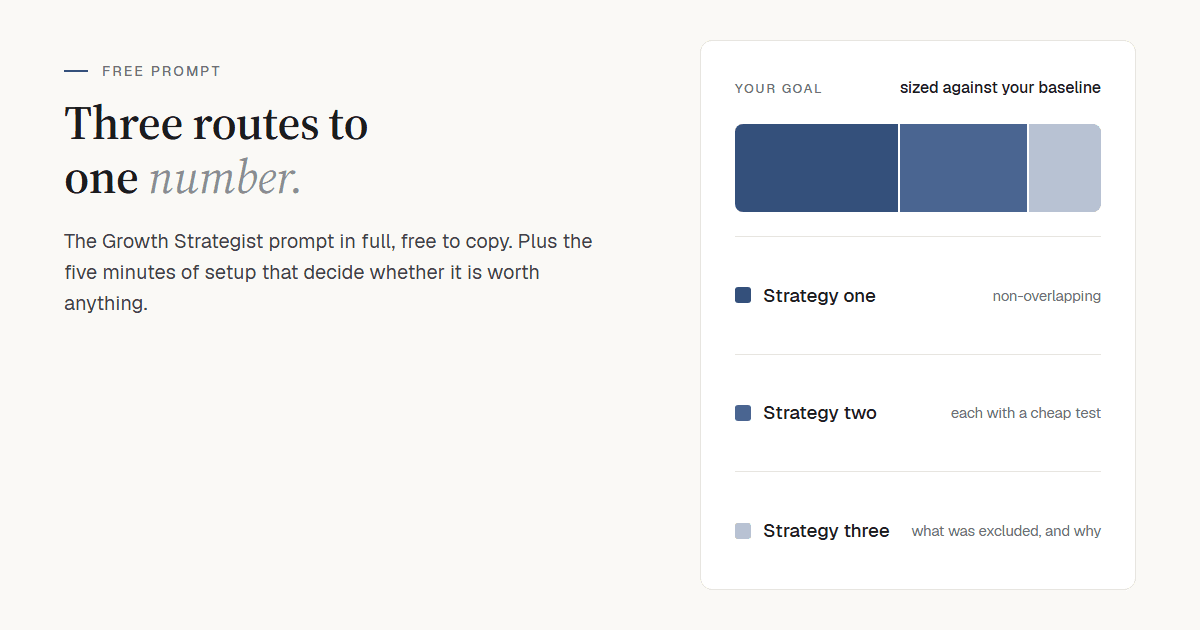
If you commented "Prompt" under the video, this is the page you were sent to. The prompt is below in full — free, no sign-up, nothing to buy.
Watch the video first if you have not: it is here.
Before you paste anything, give this page five minutes. This prompt asks a lot of the AI — it has to read your business, work out what it does not know, partition the routes to your goal so they do not overlap, size how much of the target each one delivers, and design a cheap test for each. Run it carelessly and you get the same recycled advice you would have got from a free blog post. Run it properly and you get three strategies you can actually put in front of your team on Monday.
Four things decide which of those you get.
1. Use a strong model — not the fastest
Use Claude Opus 5.5 or GPT-6. Not the default fast model, not a mini or lite variant, not an older model still selected in your account. On Claude, Opus 5.5 is the model included in the Pro plan and handles this comfortably; Fable 5.1 will do it too if your plan includes it, but the extra headroom goes unused here.
This matters more than anything else on this page. The prompt requires sustained reasoning: holding a dozen input fields in mind at once, keeping three strategies genuinely non-overlapping, doing arithmetic against your baseline, and being honest when your goal is not achievable in your timeframe. Lighter models produce something that looks like the right answer — seven neat fields, confident numbers — but the strategies quietly overlap, and the figures are invented rather than derived. That is a worse outcome than no answer at all, because it looks credible.
2. Turn thinking effort up to maximum
Both ChatGPT and Claude let you control how much reasoning the model does before it replies. Wherever your interface offers a thinking, reasoning or effort setting, set it to the highest option available. The labels move around as the products get updated, so look for the control rather than a specific word.
You are trading speed for quality here, deliberately. A stronger answer that takes ten minutes beats an instant one you cannot act on.
3. Switch on research mode
- On ChatGPT: turn on Deep Research before you send the prompt.
- On Claude: turn on Research.
Research mode lets the model go and look things up rather than working from memory alone — your website, your market, the competitors you named, what is actually happening in your category. The prompt's very first instruction depends on it: "If you can browse, check my website first and fill what you can from it." Without research mode, that step simply does not happen and the model works from whatever you typed and nothing else.
These research modes generally sit on the paid tiers, and they have usage limits. Check what your plan allows before you start, and use your allowance on this rather than on something trivial.
4. Fill in every field marked in red
The prompt has one input block near the top. Everything shown in red is a placeholder you must replace with your own detail. Delete the square brackets along with the placeholder text. Leave [BUSINESS NAME] sitting there and the prompt correctly reads it as a gap — burning one of your ten questions on something you already knew.
Two words do specific jobs:
unknown— you do not have this figure. The prompt treats it as a gap: it will either ask you about it, or state an assumption and carry on.n/a— this field genuinely does not apply to your business. Not a gap, no question.
Never guess a number to fill a space. Every contribution estimate in the output is sized off your baseline, so one invented figure corrupts all three strategies.
The fields worth thinking about before you start:
[BASELINE]and[DATA SOURCE]— the current value of the metric you want to move, and where it is measured. Not "revenue is decent". Something like "₹4.2 Cr trailing twelve months, from Tally". Where it comes from matters, because it tells the model whether you can actually measure the change.[GROSS MARGIN / AOV / CAC / LTV]— put in whatever you have and mark the rest unknown. Even one of the four sharpens the answer considerably; margin in particular decides which strategies are worth running at all.[BUDGET CEILING, with currency]— write the currency explicitly, for example "₹3 L total". This number defines the three cost bands in the output, so a vague ceiling gives you vague costings.[TEAM CAPACITY]— who can actually do this work, and for how many hours a week. This is the field owners most often skip, and it is the one that stops the model recommending things nobody has time to run.[PAST ATTEMPTS]— what you have already tried and what it returned, including the failures. Without it you will be handed back the thing that did not work last year.[REGULATORY / BRAND / OPERATIONAL LIMITS]— the things that are simply not allowed. Discounting you will not do, channels your brand will not touch, compliance you have to satisfy.[SPECIFIC GOAL]and[TIMEFRAME — a duration or an end date]— one number and one deadline. "Grow the business" is not a goal. "Increase revenue by 20% in 6 months" is. The prompt carries examples for this field; use them as the template.[TEST WINDOW, e.g. 2 weeks]— how long you will give a quick test before you judge it. Be realistic about your own follow-through.
Read your filled-in input block once before you send it. Whatever you leave thin is what the AI will guess at.
The prompt
Copy the whole thing, not just the input block — the instructions underneath it are what produce the three strategies. Every field in red is one you replace.
Act as my growth strategist for the business described in the Inputs below — a senior operator who has scaled businesses like mine and uses frameworks as tools, not as a script.
Inputs — the only place I enter information; I will fill every field. Treat anything blank, left as the original placeholder, or marked "unknown" as a gap ("n/a" means the field doesn't apply and is not a gap):

* Business: [BUSINESS NAME] · [WEBSITE]
* Offer and customer: [PRODUCT/SERVICE] sold to [TARGET CUSTOMER]
* Model and stage: [BUSINESS MODEL] · [STAGE/SIZE — revenue, headcount, years trading]
* Market and competitors: [GEOGRAPHY/MARKET] · [MAIN COMPETITORS]
* Current value of the goal metric and where it's measured: [BASELINE] · [DATA SOURCE]
* Unit economics, if known: [GROSS MARGIN / AOV / CAC / LTV]
* Channels already working: [EXISTING CHANNELS]
* Resources for growth work: [BUDGET CEILING, with currency] · [TEAM CAPACITY]
* Already tried, with results: [PAST ATTEMPTS]
* Hard constraints: [REGULATORY / BRAND / OPERATIONAL LIMITS]
* Goal: [SPECIFIC GOAL] in [TIMEFRAME — a duration or an end date]
   * Examples: "increase revenue by 20% in 6 months" · "acquire 500 new customers in 90 days" · "raise weekday footfall by 15% in 90 days" · "double email subscribers in 60 days" · "improve customer retention by 25% in Q2" · "launch in 2 new markets within 4 months"
* Start date: [START DATE]
* Quick-test window: [TEST WINDOW, e.g. 2 weeks]

Task

* Step 1 — Gap check:
   * If you can browse, check my website first and fill what you can from it
   * For each remaining field that is a gap or too vague to act on: if knowing it would change which strategies you select, it needs a question; if not, state an assumption and move on
   * If nothing needs a question, skip straight to Step 2
   * Otherwise ask me up to 10 clarifying questions, one at a time:
      * One question per reply, and nothing else in that reply; label it "Question n of up to 10"
      * Highest-impact question first; adapt each later question to my earlier answers, and drop any that an answer has already settled
      * Each answerable in a few words; if the goal names more than one target, asking which is primary counts as one of the 10
      * Wait for my answer before the next question; never start Step 2 in a reply that contains a question
   * Once the questions are done — or at any point I reply "proceed" — go straight to Step 2 with any remaining gaps covered by assumptions stated up front; do not reopen the gap check later
* Step 2 — Deliver exactly 3 growth strategies to reach the goal within the timeframe. For each:
   * Name and the single growth lever it pulls
   * Framework it draws on, plus one line on why it fits this case — no explanation of the framework itself
   * Contribution — roughly how much of the target this strategy delivers, so I can see whether the three sum to the goal
   * One quick test, runnable within the quick-test window, built so a bad result kills the idea cheaply
   * Success metric — the leading indicator that proves the test worked: current level → pass threshold, and how it maps to the goal metric
   * Rough cost: low / medium / high — define the three bands once, against my budget ceiling and timeframe
   * Next gate — the go/no-go decision: what result, by what date (within the timeframe, counted from the start date), triggers scale, pivot, or stop
* Step 3 — After the two-line verdict (see Support), close with one line asking me which I want: follow-up questions on any of the three, or three more options
   * If I want neither, stop
   * If I ask follow-ups: answer each fully against the same context, then repeat the close
   * If I want three more: first ask 2 to 5 clarifying questions, one at a time under the same mechanic as Step 1 (labelled "Question n of up to 5"); this is the only other point at which you may ask clarifying questions. Be thorough; probe what the earlier set missed, not just preferences:
      * Which of the earlier strategies came closest, and what it got wrong
      * Which lever, channel, or segment to explore or rule out
      * Whether any constraint has changed — budget, team, timeframe, risk appetite
      * Whether to widen scope to routes you previously excluded
   * Then deliver a further set of exactly 3 in the same seven-field format, under the same constraints and in the same output order:
      * Mutually exclusive of every set delivered so far — no re-skinned versions; draw first on the routes you excluded, re-examined against my answers
      * Partition sentence covering all sets so far; exclusions updated; a fresh two-line verdict on whether the new three, or the best combination across all sets, plausibly reach the goal by the deadline
   * Repeat the close after every follow-up answer or set

Constraints

* Questions: always one per reply, in every step — never bundled
* MECE:
   * Mutually exclusive — each strategy pulls a different lever (e.g. new customers vs. more from existing customers vs. new market or offer); no overlap in mechanism, channel, or segment
   * Collectively exhaustive — together they cover the credible routes to this goal; name what you deliberately excluded and why, one line each
   * Say plainly if one strategy in a set is materially weaker than the others rather than dressing it up
* Frameworks — choose what fits the goal type and stage rather than defaulting; substitute a better-fitting framework if one exists; name what you use, don't teach it:
   * Ansoff Matrix or revenue-equation decomposition — to partition the opportunity space
   * AARRR / growth accounting — to locate the bottleneck
   * JTBD — for customer insight
   * Porter's Five Forces / PESTLE — for market entry
   * Unit economics (CAC, LTV, payback) — to sanity-check
   * ICE / RICE — to pick the strongest three from your candidates
   * Lean build-measure-learn — for test design
   * Stage-gate — for gates
* Fit my actual budget, team, and constraints — nothing that needs resources I don't have
* No generic advice ("improve SEO", "post on social media") — every recommendation specific to this business and market
* Never invent figures; label estimates as estimates and show the working behind them
* Format: the same seven fields, in the same order, for every strategy — no prose between them beyond what's asked

Tone

* Direct, practitioner-to-owner; no hedging, filler, or marketing language
* If the goal is unrealistic in the timeframe, say so before the strategies, state what is realistic, and build every set against that target

Support

* Output order: assumptions (if any) → realism call (if needed) → the three cost bands → one sentence showing how the strategies partition the opportunity space → the three strategies → what you excluded and why → a two-line verdict on whether these three, executed well, plausibly reach the goal by the deadline → the Step 3 close
* Distinguish fact from reasoned inference throughout
What happens after you send it
The prompt runs a conversation, not a one-shot answer. Three stages:
Stage one — the gap check. It reads your inputs, looks at your website if it can, and works out what it still needs. Then it asks you up to ten questions, one at a time, labelled "Question 1 of up to 10" and so on. Each is answerable in a few words. It adapts as it goes, dropping questions your earlier answers have already settled.
This is the part most people rush, and it is the part that determines the quality of everything after it. Answer properly. If you have had enough, reply proceed and it will go straight to the strategies, covering whatever is still missing with assumptions it states up front.
Stage two — the three strategies. Assumptions first, then a realism call if your goal does not fit your timeframe, then the definitions of low, medium and high cost against your budget. Then three strategies, each in the same seven fields: name and lever, framework, contribution, quick test, success metric, cost, and the go/no-go gate with a date. Then what it deliberately left out and why, and a two-line verdict on whether the three actually get you there.
Stage three — the close. It asks whether you want follow-up questions on any of the three, or three completely different options. Ask for three more and it will first put two to five sharper questions to you, then produce a set that does not overlap with anything it has already given you. You can keep going. If you are done, say so and it stops.
Getting a better answer out of it
- Give it a real website. The
[WEBSITE]field is what lets research mode see your actual offer and pricing rather than your description of them. If your site is thin or out of date, say so in[PRODUCT/SERVICE]instead. - Name real competitors. "Various local players" tells it nothing. Two or three names tells it a great deal.
- Push back on the verdict. If the two-line verdict says the three strategies do not reach your goal, that is useful information, not a failure. Ask for three more before you change the goal.
- Check the arithmetic yourself. The contribution figures are estimates and the prompt requires the model to label them as such and show its working. Read that working. If it does not add up against your baseline, say so and make it redo the sizing.
- Take the gates seriously. Each strategy comes with a date and a decision. Put those dates in your calendar the day you finish the session, or the whole exercise stays theoretical.
If something looks wrong
It gave me strategies without asking anything. Research modes sometimes run all the way to a finished report in one pass. If you get the three strategies straight away, check whether the assumptions block at the top is reasonable. If it has assumed something material and wrong, correct it and ask it to redo Step 2. To force the questions, run the gap check in a normal chat first, then take your completed input block into research mode.
The advice is generic. Almost always one of two causes: a weaker model than the two named above, or thin inputs. Check the model first, then reread what you put in [PAST ATTEMPTS], [MAIN COMPETITORS] and [TEAM CAPACITY].
The numbers look invented. Ask it directly: "show the working behind the contribution figure for strategy two." The prompt already forbids invented figures and requires the working, so this is a fair challenge, not a favour.
Two strategies feel like the same idea. They are meant to be mutually exclusive. Say so and ask it to replace the weaker one with a strategy pulling a different lever.
It asked several questions in one message. Reply: "one question per reply, please" and it will fall back into line.
One caution before you paste
Whatever you type goes to a third party. Keep customer names, personal data and anything covered by a client confidentiality clause out of the input block — aggregate figures and descriptions are all this prompt needs. Under India's DPDPA 2023 that responsibility sits with you as the business holding the data, not with the AI vendor. Baseline revenue, margin percentages and a description of your customer segment are fine. A list of your customers is not.
Prompts like this are what we build with owners at our two-day workshop — hands-on, on your own numbers, with the tests scheduled before you leave the room. Details: Accelerate Your Profits with AI.
Related articles
Put this to work in your own business
We train 325+ owners across Delhi NCR hands-on, on their own data — in 2 days.