
Opus 5.5 Launches: A Cheaper Default Than Fable 5.1 for Everyday Knowledge Work
By AI Business Partners · 23 Sep 2026
Updated 20-Nov-2026: Fable 5.2 and its price added; comparison corrected to half the price of the current Fable; Pro price in rupees and a worked example added.
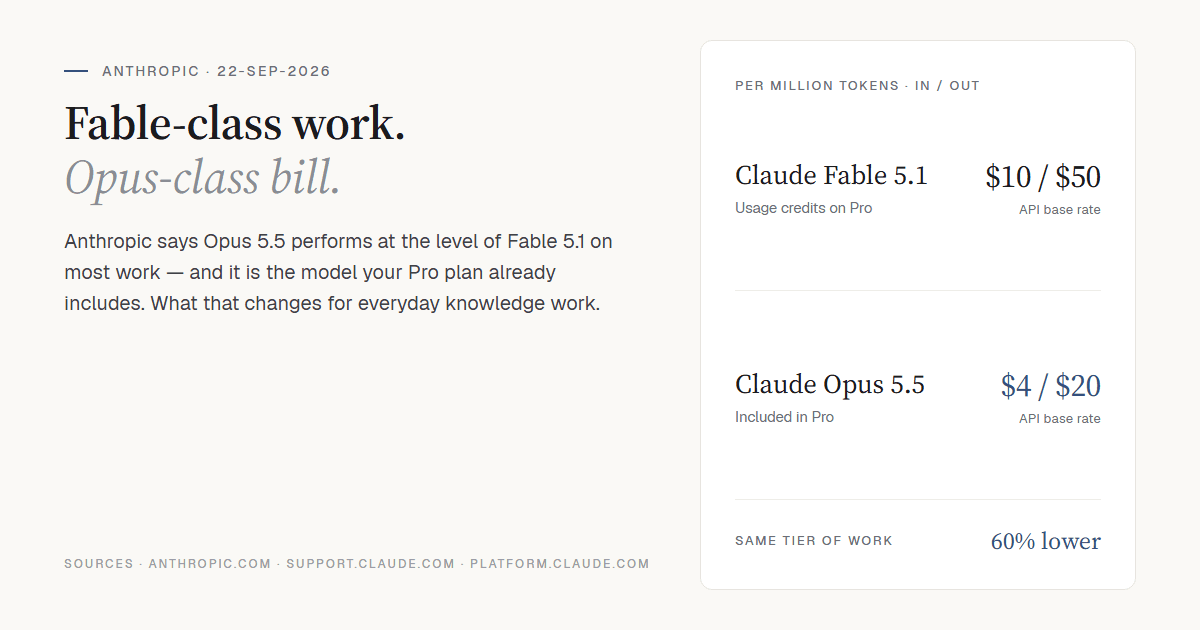
Updated on 20-Nov-2026. Anthropic released Claude Fable 5.2 on 09-Nov-2026, priced at USD 8 per million input tokens and USD 40 per million output tokens. Against the current Fable, Opus 5.5 costs half as much per token. The "60% less" in the first version of this post compared it with Fable 5.1, which is still on Anthropic's price list at USD 10 and USD 50. The advice has not changed: make Opus 5.5 the default. Anthropic's own model guide now says the same.
Anthropic launched Claude Opus 5.5 on 22-Sep-2026, and for most business teams it quietly changes the default maths. In Anthropic's own words, Opus 5.5 "performs at the level of Claude Fable 5.1 on most work" while costing far less to run — and, crucially, if you pay for Claude, it is the model you already have.
The access gap is the headline
On the Claude Pro plan, Opus 5.5 is the included, default Opus-tier model. Fable is not. Anthropic's Help Center says that on Pro the Fable models (5, 5.1 and 5.2) are not part of the plan's usage limits: they run on pay-as-you-go usage credits.
Pro costs USD 20 a month, or USD 200 for a year paid up front. At ₹94 to the dollar that is about ₹1,880 a month (20 × 94) or about ₹18,800 a year (200 × 94), before taxes and card charges. Anthropic's pricing page shows no rupee price.
For a Pro subscriber doing research memos, drafting, summarisation and analysis, choosing Fable means paying extra per task. Choosing Opus 5.5 does not.
One caveat worth knowing before you set a team policy: on Max and Ultra plans, and on premium Team and Enterprise seats, Fable is included as a standard part of the plan (up to half of the weekly limit). The access gap is a Pro and standard-seat story. The cost and efficiency story below applies to everyone.
One exception has already come and gone. For the launch week of Fable 5.2, from 09-Nov-2026 to 16-Nov-2026, Pro plans and standard Team seats had Fable included in their weekly limits, up to half of the limit. That week is over, and Fable is back on usage credits for them.
On the API, the economics point the same way
The API is the route developers use to build Claude into their own software, and it is billed by the token. Tokens are the small pieces of text a model reads and writes, counted in millions.
Opus 5.5 costs USD 4 per million input tokens and USD 20 per million output tokens. Fable 5.2 costs USD 8 and USD 40, so Opus 5.5 is half the price per token. Against Fable 5.1, still listed at USD 10 and USD 50, it is 60% lower. Cache reads — the discounted rate for text the model has already been sent once — cost USD 0.20 per million.
Anthropic estimates typical workloads cost about 40% less than on Opus 5, partly because Opus 5.5 also uses fewer tokens per task. Box, which runs AI agents across large volumes of documents, found Opus 5.5 used about a third as many tokens as Opus 5 while producing answers that were 40% less verbose without losing accuracy.
A worked example. Say a document pipeline reads 1,000 documents a month, about 10,000 tokens each, and writes a 1,000-token summary of each. That is 10 million input tokens and 1 million output tokens a month. At list prices:
- Opus 5.5: (10 × 4) + (1 × 20) = USD 60, about ₹5,640
- Fable 5.2: (10 × 8) + (1 × 40) = USD 120, about ₹11,280
- Fable 5.1: (10 × 10) + (1 × 50) = USD 150, about ₹14,100
The rupee figures use ₹94 to the dollar. The sums assume no caching and the same number of tokens on every model. That second assumption is the one to test.
What this means for your business: if you have anyone building on the API — a WhatsApp bot, a document pipeline, an internal tool — and it runs on a Fable model, a straight swap to Opus 5.5 at least halves the list price. If it runs on Opus 5, Anthropic's estimate is a running cost about 40% lower. Test it on your own real workload, not on the published numbers.
Where Fable still wins
Fable sits in Anthropic's top tier. Fable 5.2 is the same underlying model as Mythos 5.2 with extra safeguards; Mythos itself is limited to vetted organisations, so it is not an option for a typical business. Anthropic's model guide says to start with Opus 5.5 for most work, and to move up to Fable 5.2 for demanding reasoning and long-running agent work, or when Opus 5.5 at a higher effort setting still falls short in your own tests.
For everyday knowledge work, that headroom usually goes unused. You are paying for a capability the task never calls on.
How the lineup fits together now
- Haiku 5.5 — high-volume, simple tasks: classification, extraction, first-pass triage.
- Sonnet 5.5 — balanced production work where cost and speed matter.
- Opus 5.5 — the default for serious knowledge work: research, drafting, analysis, summarisation.
- Fable 5.2 — only for the hardest, long-horizon jobs, or when Opus 5.5 at higher effort demonstrably falls short.
On Claude's Free plan you get Sonnet and Haiku. Opus starts with Pro.
The practical takeaway
If your team runs standard professional work on Claude, make Opus 5.5 the default and escalate to Fable 5.2 only when a specific task fails at higher effort. On Pro and standard Team seats you avoid the usage-credit surcharge; on Max, Ultra and premium seats you keep your Fable allowance for the work that needs it.
One honest note: "performs at the level of Fable 5.1 on most work" is Anthropic's own, vendor-run claim, and it was made about Fable 5.1. Anthropic's benchmarks for Fable 5.2 put it ahead of Opus 5.5 on almost every test it reports. Validate the choice on your own tasks before you change a policy — and keep an eye on the escalation cases, because those are where the real difference lives.
Working out which of your workflows sit in the "everyday" bucket and which genuinely need the top tier is exactly the kind of question we work through with owners in our workshops and one-to-one consulting.
AI Business Partners helps SMB owners and CXOs across Delhi NCR turn AI skills into business wins.
Sources
- Anthropic, "Introducing Claude Opus 5.5" (22-Sep-2026), including Box's assessment: https://www.anthropic.com/claude-opus-5-5
- Anthropic, "Introducing Claude Fable 5.2 and Claude Mythos 5.2" (09-Nov-2026): https://www.anthropic.com/claude-fable-and-mythos-5-2
- Anthropic, "Models overview", for current prices and the guidance on which model to start with: https://platform.claude.com/docs/en/about-claude/models/overview
- Claude Help Center, "Claude Fable models on your plan": https://support.claude.com/en/articles/15424964-claude-fable-models-on-your-plan
- Claude Help Center, "Claude Fable 5.2 launch offers": https://support.claude.com/en/articles/17506494
- Claude plans and pricing: https://claude.com/pricing
Facts checked on 20-Nov-2026.
Related articles
Put this to work in your own business
We train 325+ owners across Delhi NCR hands-on, on their own data — in 2 days.